
By Alex Stillo, founder of AMS, in Houston · November 13, 2026
A permission slip, not a blank check
How Amy makes the in-between decisions on a custom shirt order, and why she is never allowed near the money.
Most of the work in a custom shirt order happens in between. You know what you want: 24 shirts that say Ortega Family Thanksgiving 2026, in hand before the 25th. Between that sentence and a proof you can approve sit a run of small calls. Which design direction is strongest. Whether a thin line will survive the print. Whether the lettering needs a cleaner edge.
Amy, the AI ordering assistant in AMS Studio, does that work. Until now she asked before each step that spends Studio credits, which includes every design pick and every artwork change. That was the safe default. It was also a lot of tapping for people who had already told her what they wanted.
The tempting fix
The obvious way to cut the tapping is a switch: let Amy decide. We didn’t build that, because a switch like that is a blank check. It has no amount on it, no end date, and no record of what it covered.
So we built a permission slip instead. It names what it covers, shows its limit before you sign, and expires.
A switch is a blank check. A plan is a permission slip: an amount, an end date and a list of what it covers.
One card, three answers
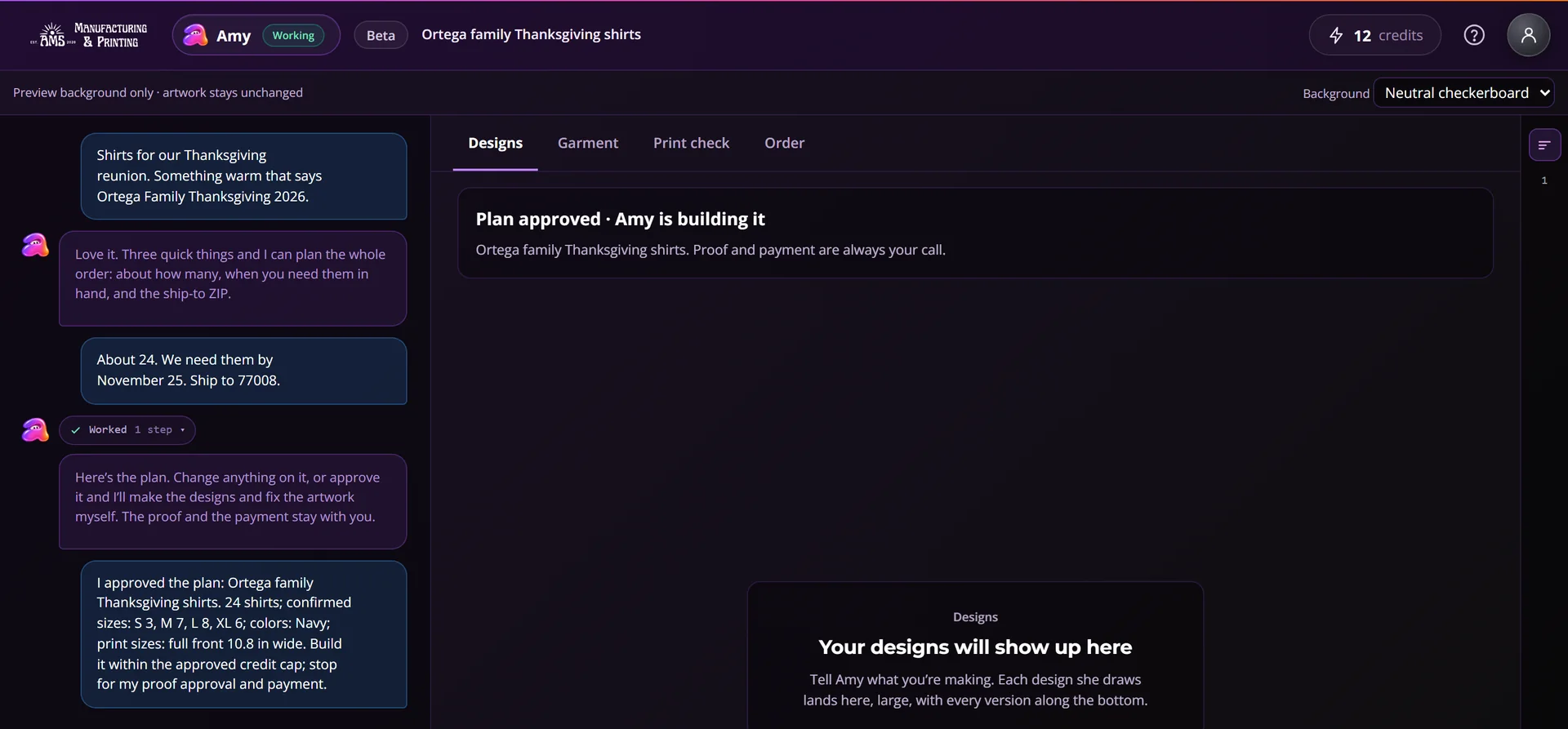
Once Amy knows enough about the order (what the shirts say or show, about how many, when you need them and where they ship), she puts one plan in the workspace. It lists the steps, the in-hand date, the estimated total when she has one, and a credit cap. Then it answers three questions in plain words.
Amy does without asking
Makes and refines your artwork within the credit cap. Amy picks the strongest; the others stay in your designs.
Amy stops and checks with you if
More credits are needed, or you edit the plan or workspace.
Always your call
Approving the proof and paying.
You can change the sizes, the garment colors and the print size right on the card. Then you either approve it, or tap Change something and tell Amy what is off.
Seven rules for an assistant that acts on its own
A plan is only worth approving if its limits are easy to trust. These are the rules Studio follows today.
Show the limit before asking for the yes.
The plan reads “Up to 8 credits,” or whatever your number is, before you approve. That number is the Studio credit balance you have at that moment, so you agree to a figure you can read, not an open account. If a step would go past what is left, or past your balance, Amy brings that decision back to you.
Permission points forward, never back.
A plan covers choices Amy raises after you approve it. If a decision was already waiting for you, it stays yours. Approving a plan should never quietly settle something you had not looked at yet.
Your touch takes it back.
The moment you change anything in the workspace yourself, the plan stops covering anything. We read your edit as “I’m driving now,” and Amy goes back to asking before each step.
It ends on its own.
A plan’s permission lasts 24 hours from the moment you approve. Nobody has to remember to switch it off.
Never twice.
If the same request arrives twice, from a retry or a dropped connection, it is recognized and counted once. A step is never charged twice.
The money is not delegable.
No plan can approve a proof, review the order, check out or touch anything involving money after purchase, whatever the cap says. Amy can take you all the way to a proof. You approve it, and you pay.
There is an off switch.
AMS can turn plans off at any time. Amy stops offering them, and an approved plan stops approving anything. She goes back to asking before every step.
You can see every decision it made
Each step a plan covers shows up in your workspace history marked “Approved by your plan.” The approval itself is recorded too, in words you can read later: “Amy can use up to 8 Studio credits; proof and payment still need your approval.” Amy picks the design she thinks is strongest, and the others stay in your Designs. Ask “what else did you make?” and she shows them.
Why a print shop cares about this
We are a print shop in Houston. Our customers order for teams, schools, businesses and events. None of them want to supervise software. They want the shirts right, on time, with no surprises on the bill.
Doing more for people means deciding more on their behalf. We think that only works when the limit is visible before you agree, the permission is narrow and short-lived, and the parts that cost real money never leave your hands.
Every business that puts an AI assistant in front of its customers will face the same question: how much should it decide on its own? Our answer, for now, fits on one card.