Quick Answer
Quick answer
No. DTF transfer quality can change with artwork readiness, pass count, film behavior, curing, support, shipping, and application.
Cheap DTF transfers can be fine for samples and flexible jobs. They get risky when the order has a fixed deadline, high quantity, customer-supplied blanks, or front/back pressing.
In Houston, local pickup can be worth more than a small sheet-price gap because it removes carrier delay and gives you a faster support path.
If the order cannot miss, ask AMS whether transfer-only, blanks plus transfers, or finished apparel is the safer path.
No, all DTF transfers are not the same
DTF transfers can look interchangeable when the only thing on the screen is a sheet size and a price. That is the trap. The real product includes artwork readiness, printer settings, film behavior, pickup or shipping timing, support, and what happens if something goes wrong.
Cheap DTF transfers can be fine when the job is a flexible sample. They get risky when a Houston event, school order, church group, restaurant launch, or crew handout depends on the transfer being right and on time.
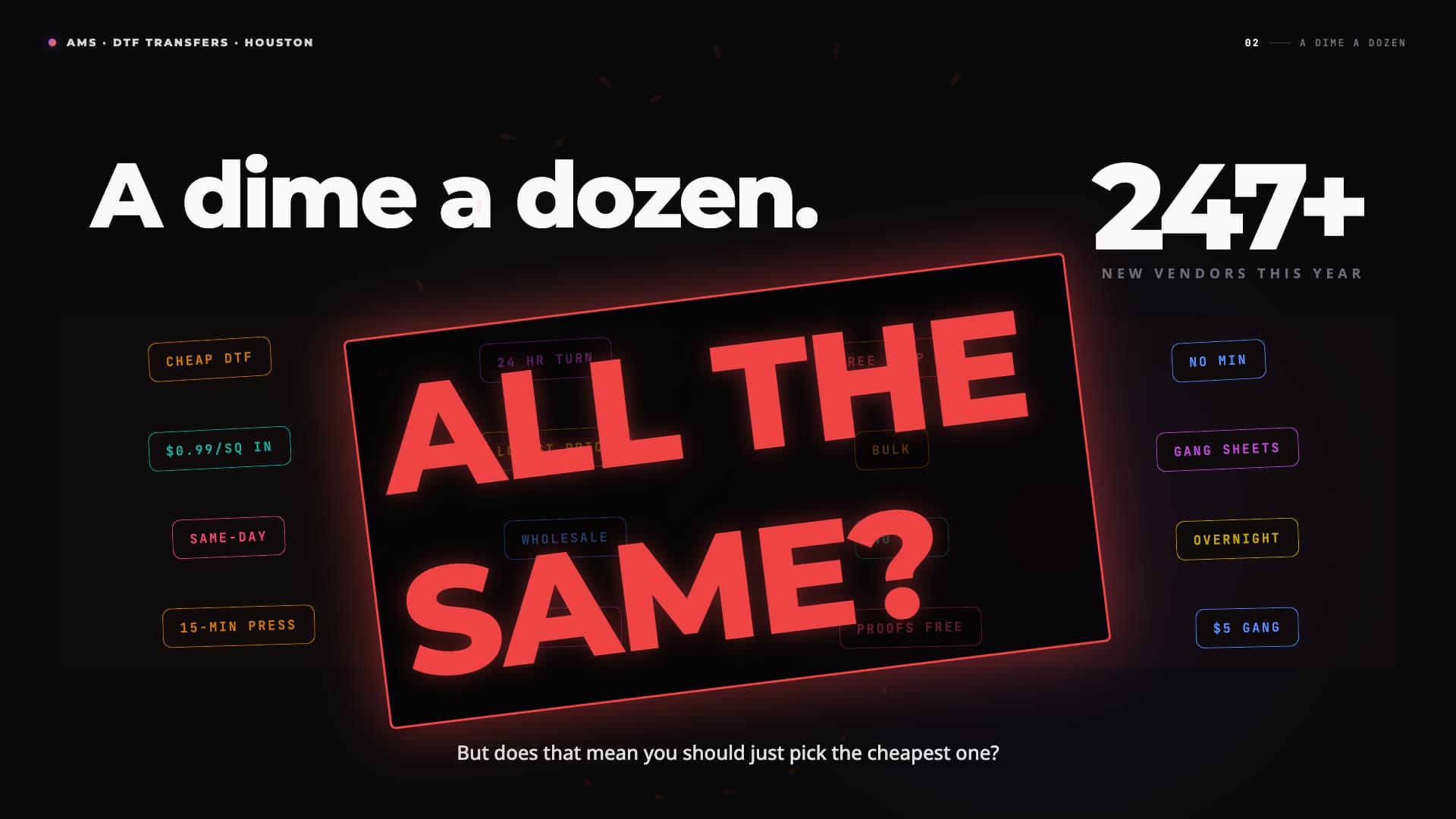
The better question is not who has the lowest sheet price. The better question is what risk is bundled into that price.
The $28 shipped transfer versus $35 local pickup
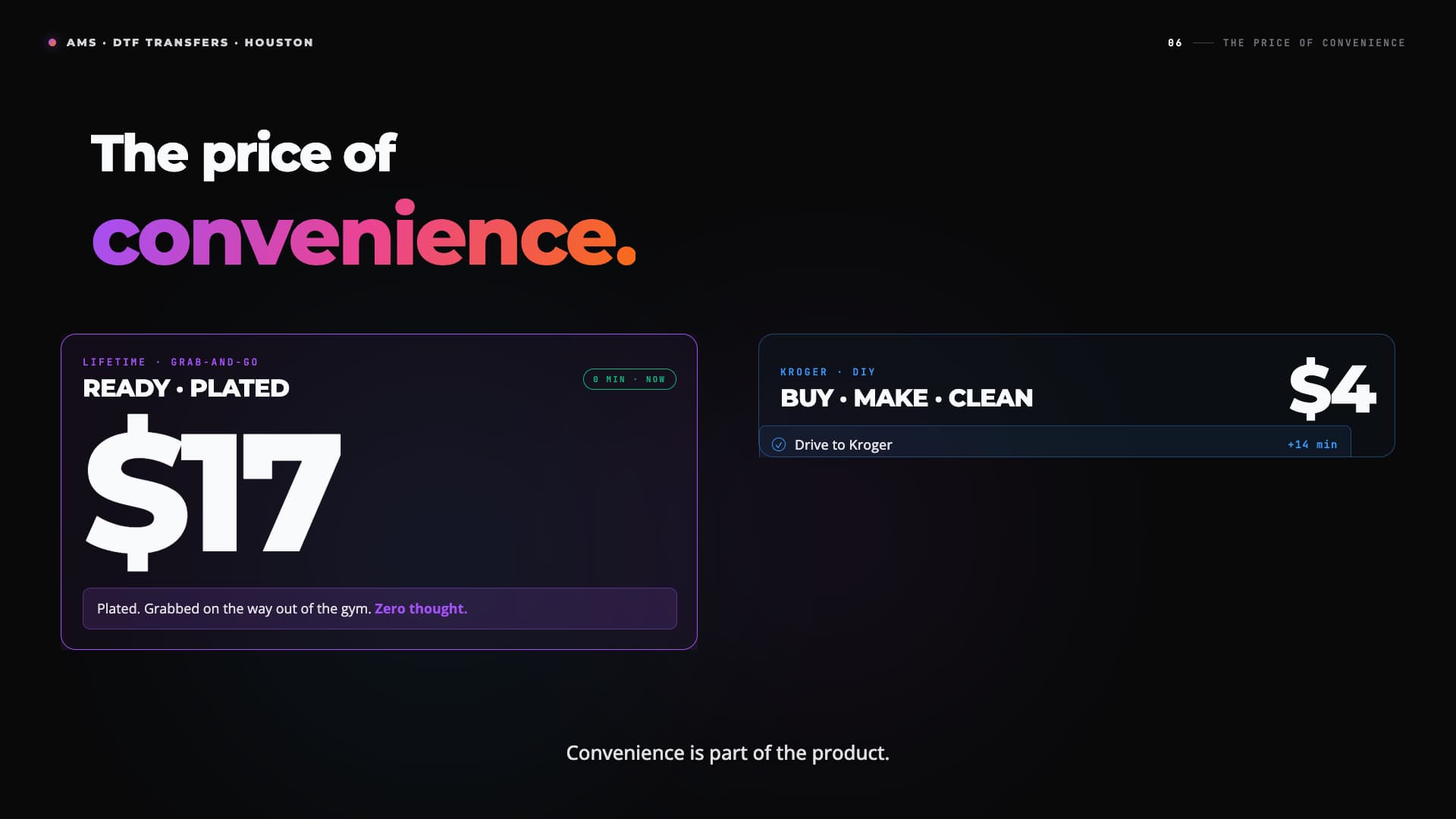
Alex's video gives the simplest version of the math: a $19 22x36 transfer plus $9 shipping is $28, while a local pickup transfer might be $35. On the checkout page, the shipped option looks $7 cheaper.
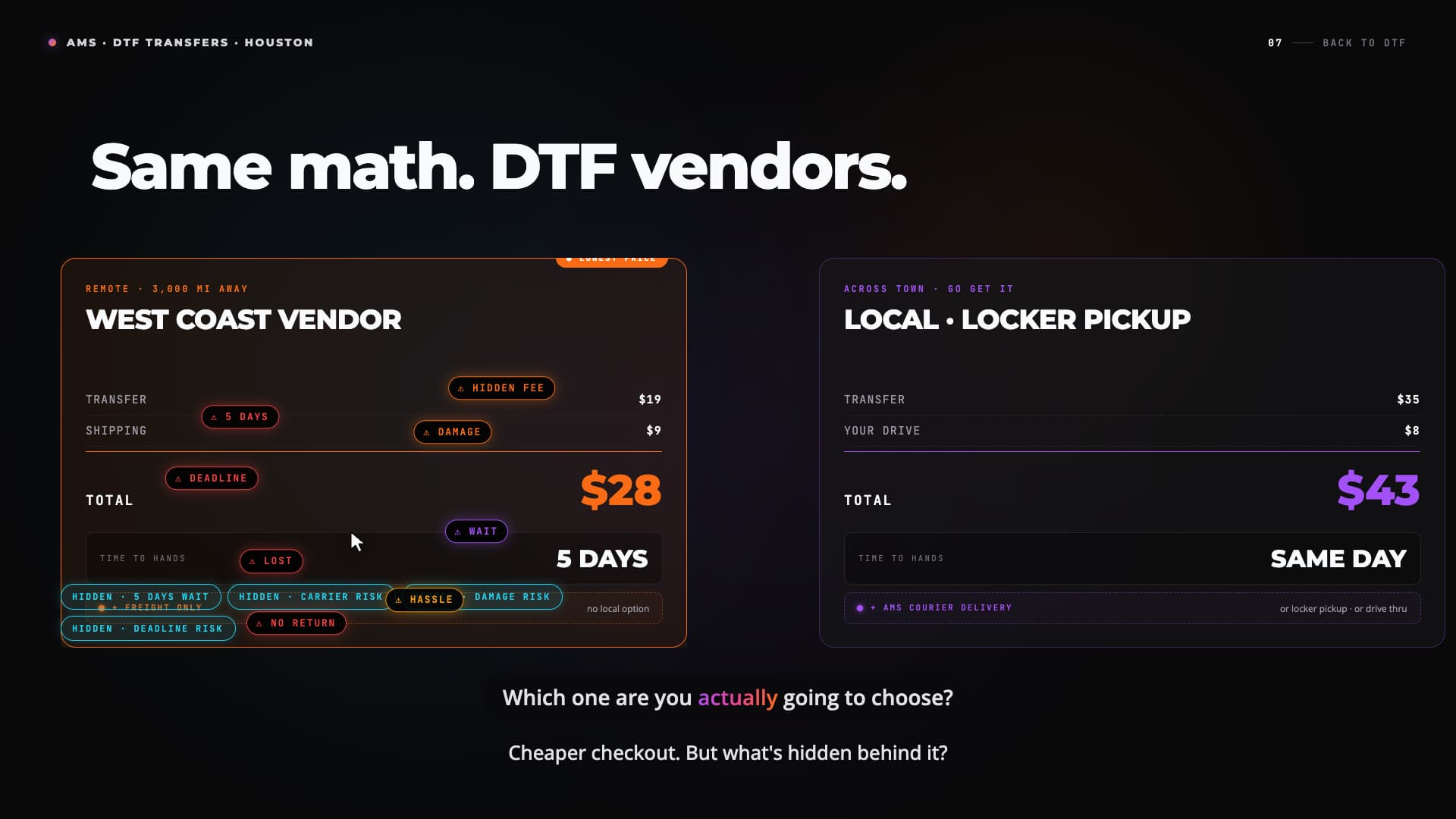
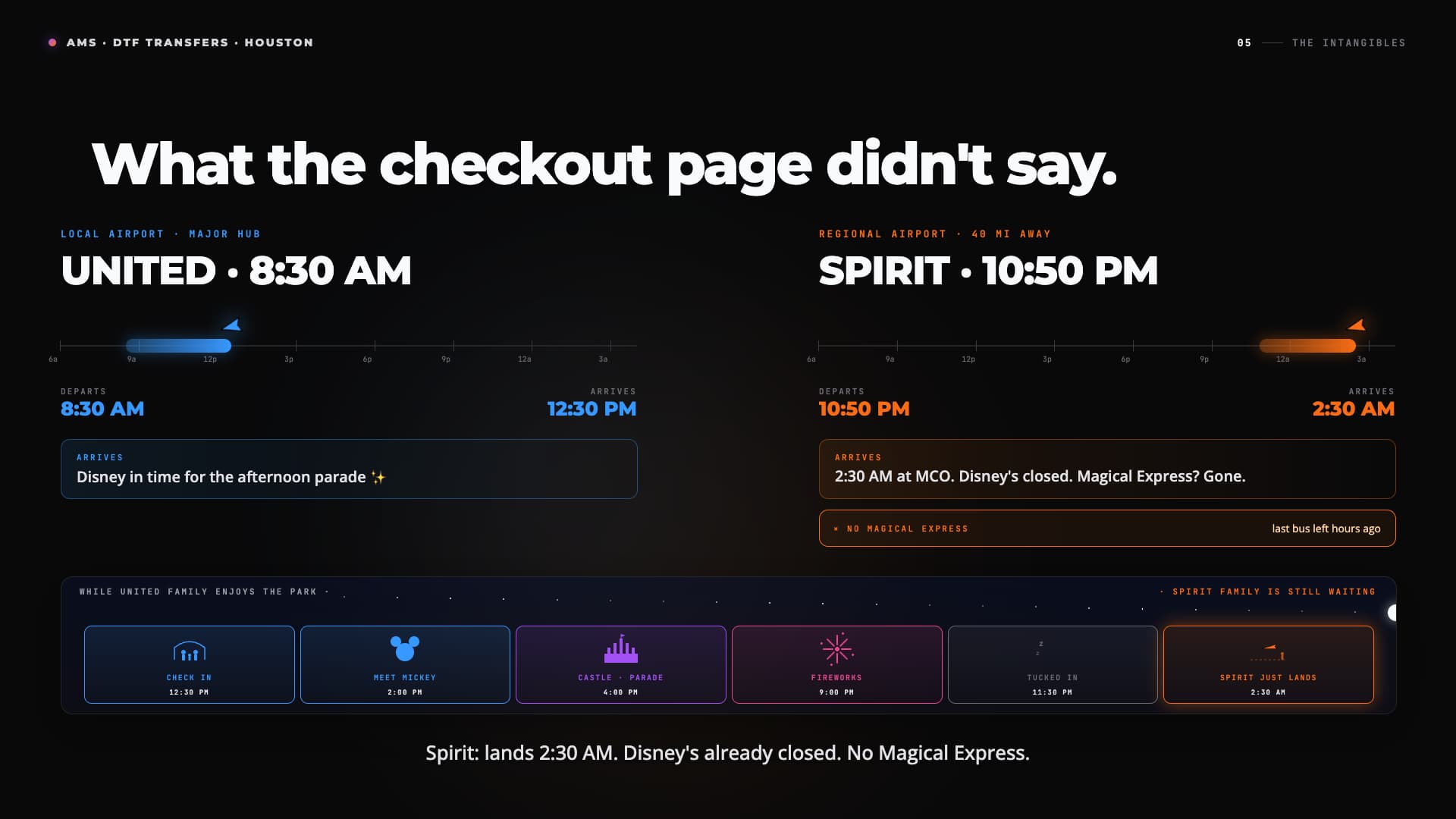
The hidden cost is the five extra days in the example, plus carrier delay, package damage, missed delivery, and whether support can actually help before the customer deadline. That is why same-day DTF pickup and transfer turnaround matter for Houston buyers.
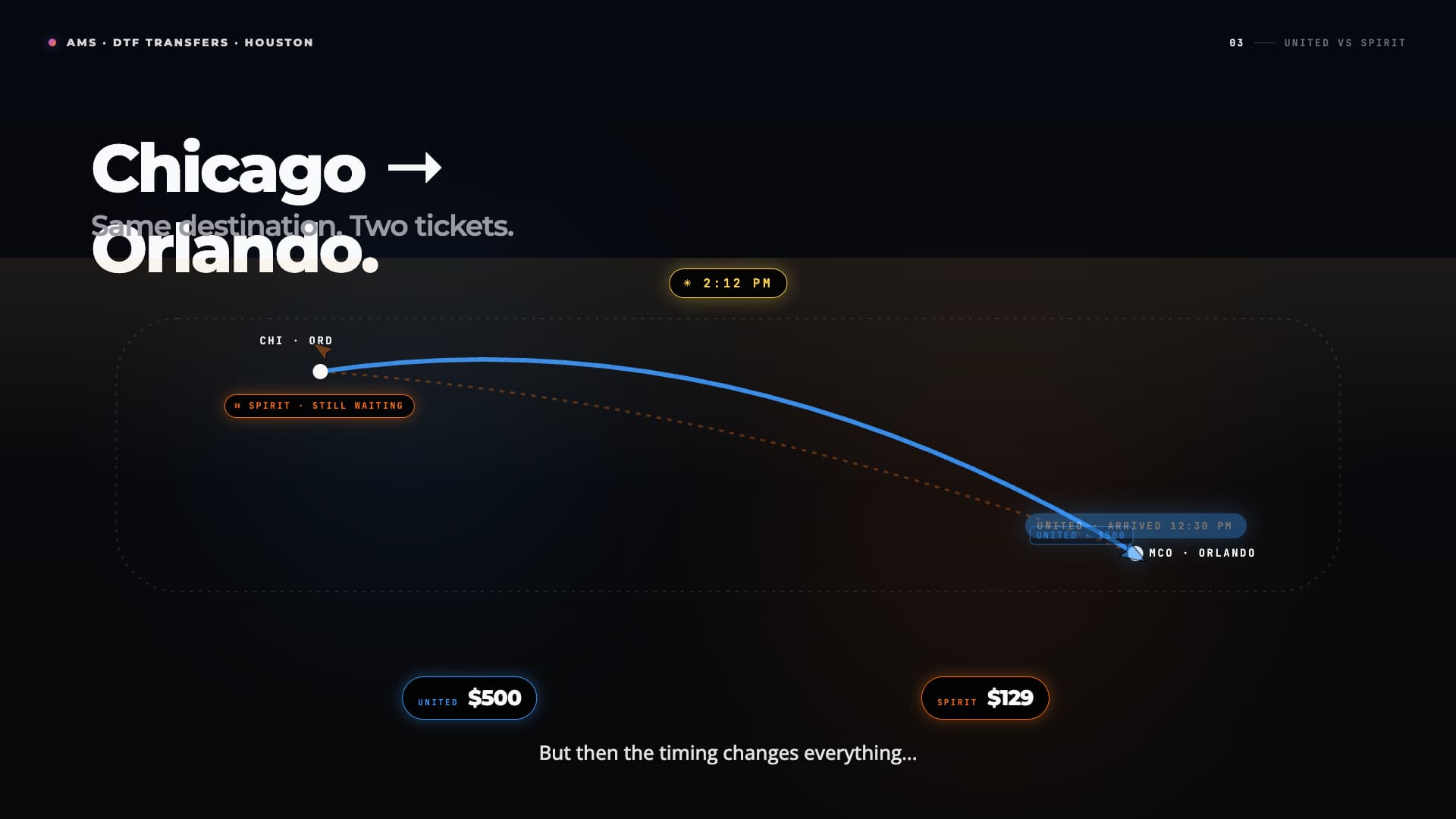
A $7 price gap can be a bad trade if the job cannot survive five extra days or a lost package.
What changes transfer quality after the file is ready
The artwork still matters first. Use the transfer file requirements before judging any vendor. A low-res, wrong-size, or fake-transparent file can make a good vendor look bad and can make a cheap vendor look worse.
After the file, ask about printer settings, pass count, film type, curing, storage, shipping, and application guidance. The best DTF transfers are not just colorful in a photo; they survive the real press, peel, customer, and deadline.
A clean file is the starting point, not the full quality guarantee.
4-pass versus 8-pass is a buyer question
Pass count matters because printer time has a cost. Alex says customers often bring in transfers that did not meet expectations and looked like low-pass output. He contrasts four-pass with eight-pass because the extra printer time can produce a visibly stronger result.
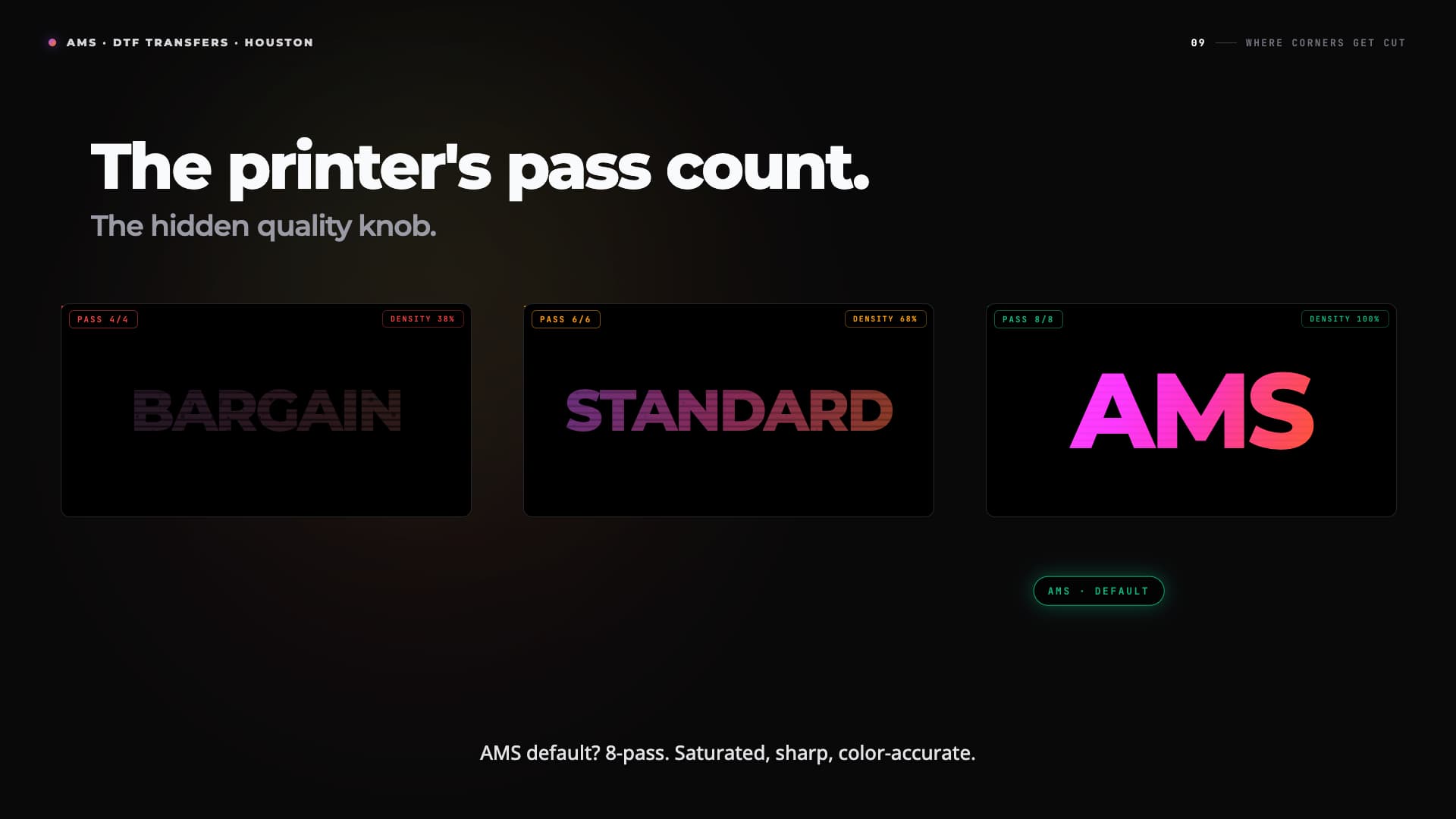
Do not treat pass count as the only thing that matters. Treat it as a vendor question. If a shop sells cheap DTF transfers but cannot explain quality settings, samples, or replacement policy, you do not know what you are buying.
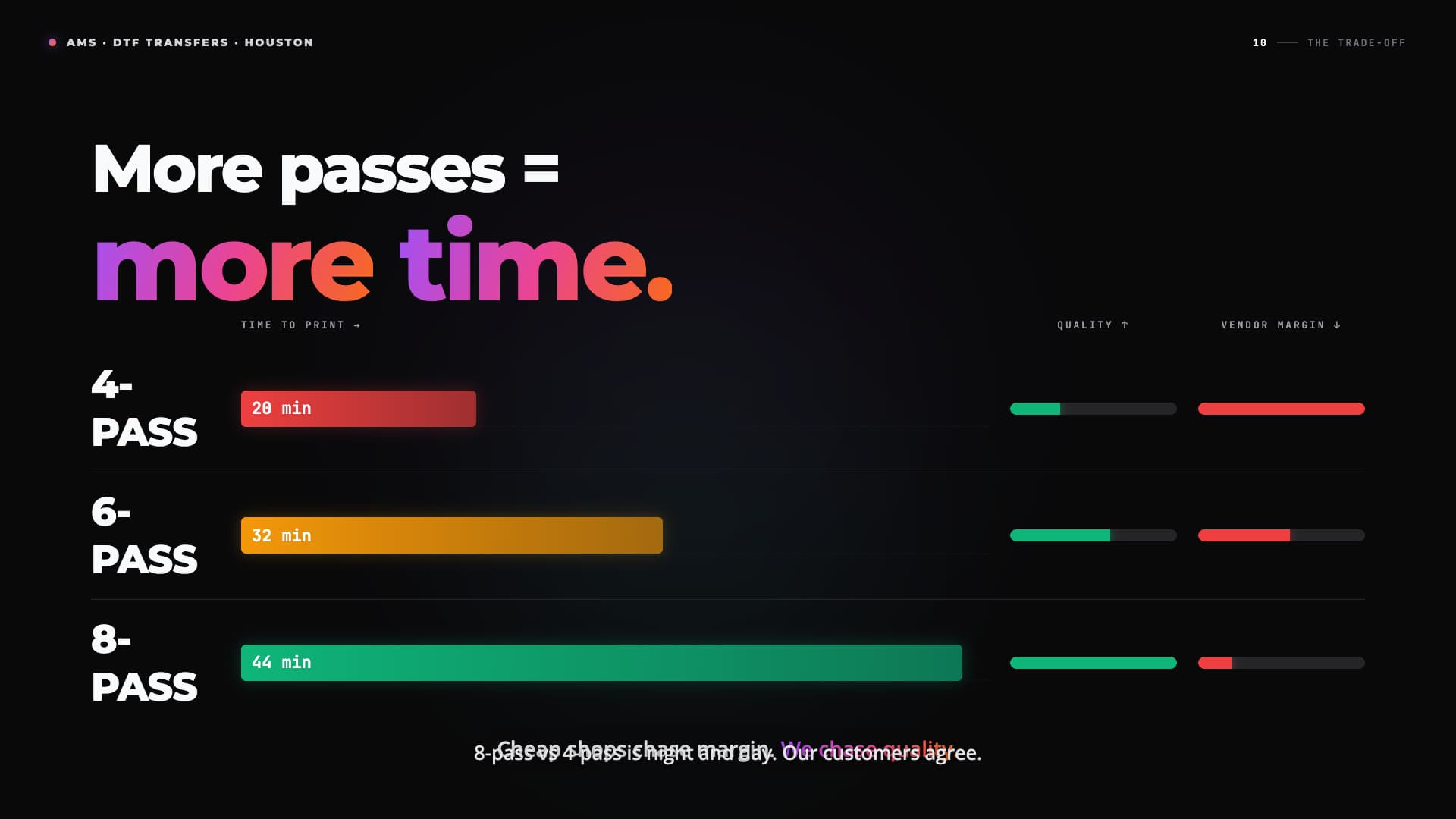
Ask how the vendor protects print quality before making a customer deadline depend on the lowest price.
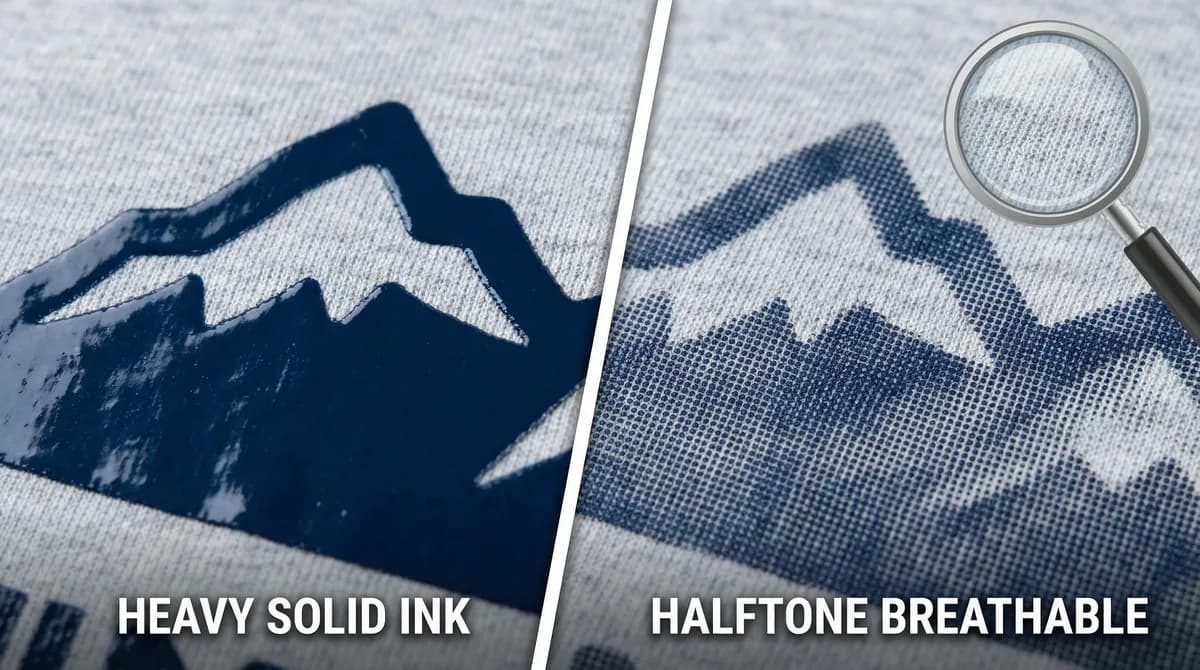
Cold peel can move cost to the person pressing
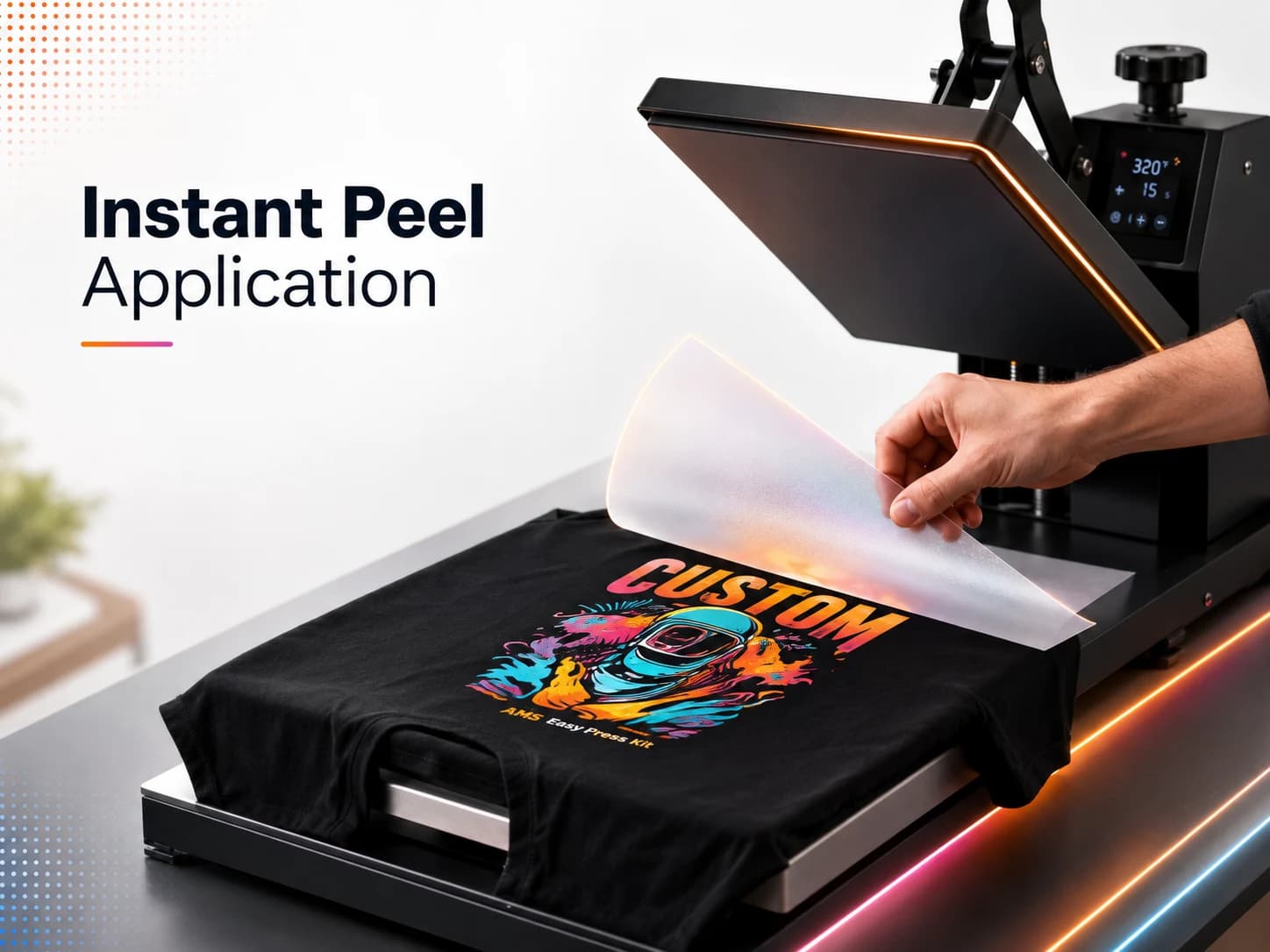
Cold peel can be cheaper and easier for a vendor, but it can slow the person pressing. Alex says cold peel took AMS about 50% longer on a 100-shirt front/back job. In his simple math, a 2-hour instant peel job becomes a 3-hour cold peel job.
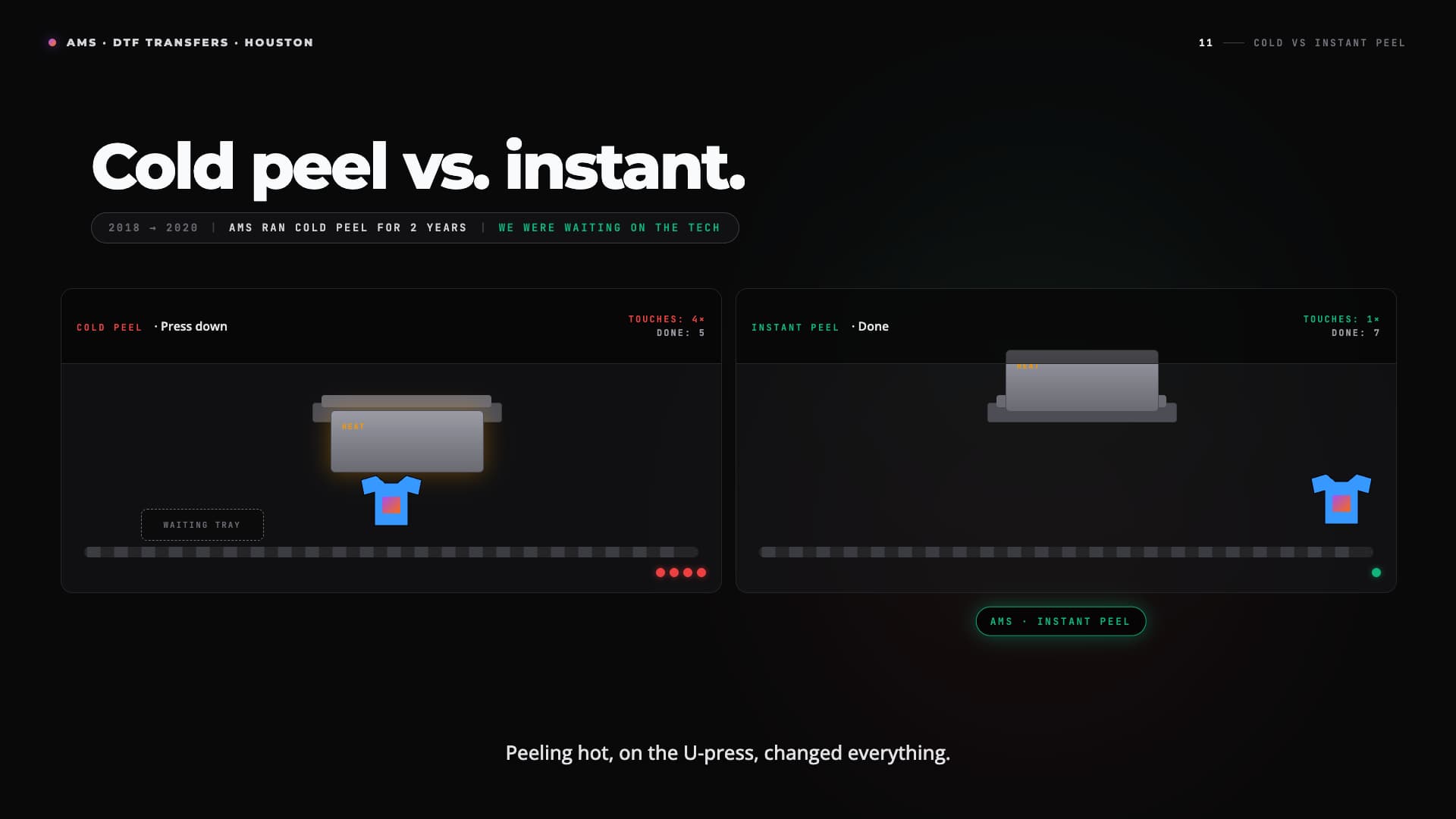
If your team is pressing in-house, peel type belongs in the quote. Use the how to apply DTF transfers guide, test one shirt, and count pressure, peel, and inspection before deciding that transfer-only is cheaper.
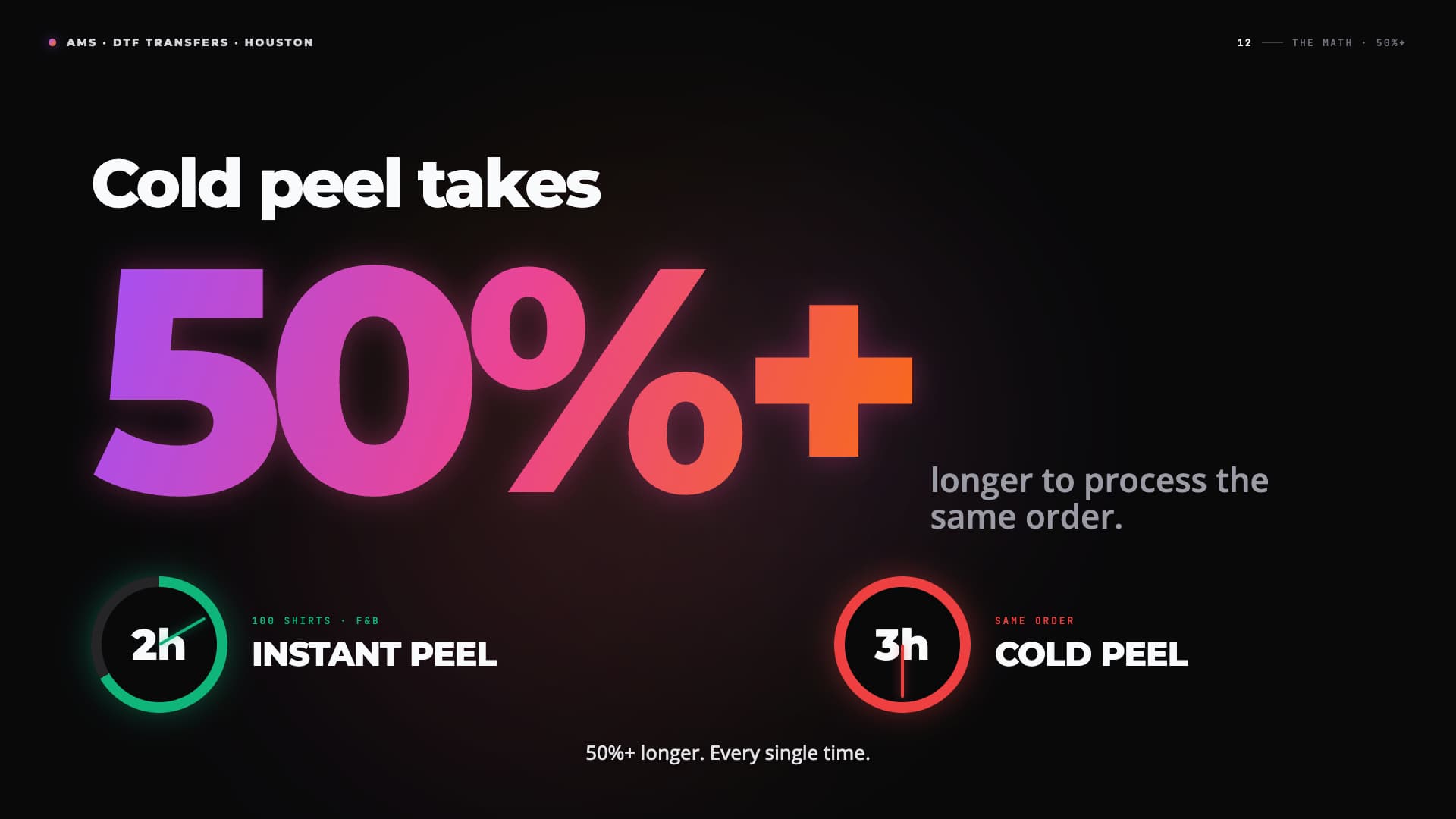
A cheaper transfer can still be expensive if it adds labor to every shirt on the heat press.
When cheap DTF transfers are fine
Cheap can be fine for a sample, flexible reorder, low quantity, or shop test where the art is clean and the deadline can move. That is the honest answer. A low price is not a red flag by itself.
The red flag is missing information. If the vendor cannot explain timing, pass count or quality policy, peel type, replacement process, shipping risk, or support, do not use that vendor for the first time on a customer job that cannot move.
Cheap works when the downside is small. It gets risky when the order has no room to fail.
Vendor red flags from the Houston story
The Houston vendor story in the video is about embroidery, but the lesson applies to transfer vendors. The cheapest of three quotes looked acceptable. Then 20 of 80 hats were missing at pickup, replacements had to be bought, and the original missing hats were found later.
The product price did not show the mental bandwidth, replacement spend, customer communication, and deadline risk. That is why support, count accuracy, and replacement policy are part of the transfer decision.
A vendor mistake can cost more than the original savings, especially when customer-supplied blanks or event dates are involved.
Houston pickup turns timing into a quality factor
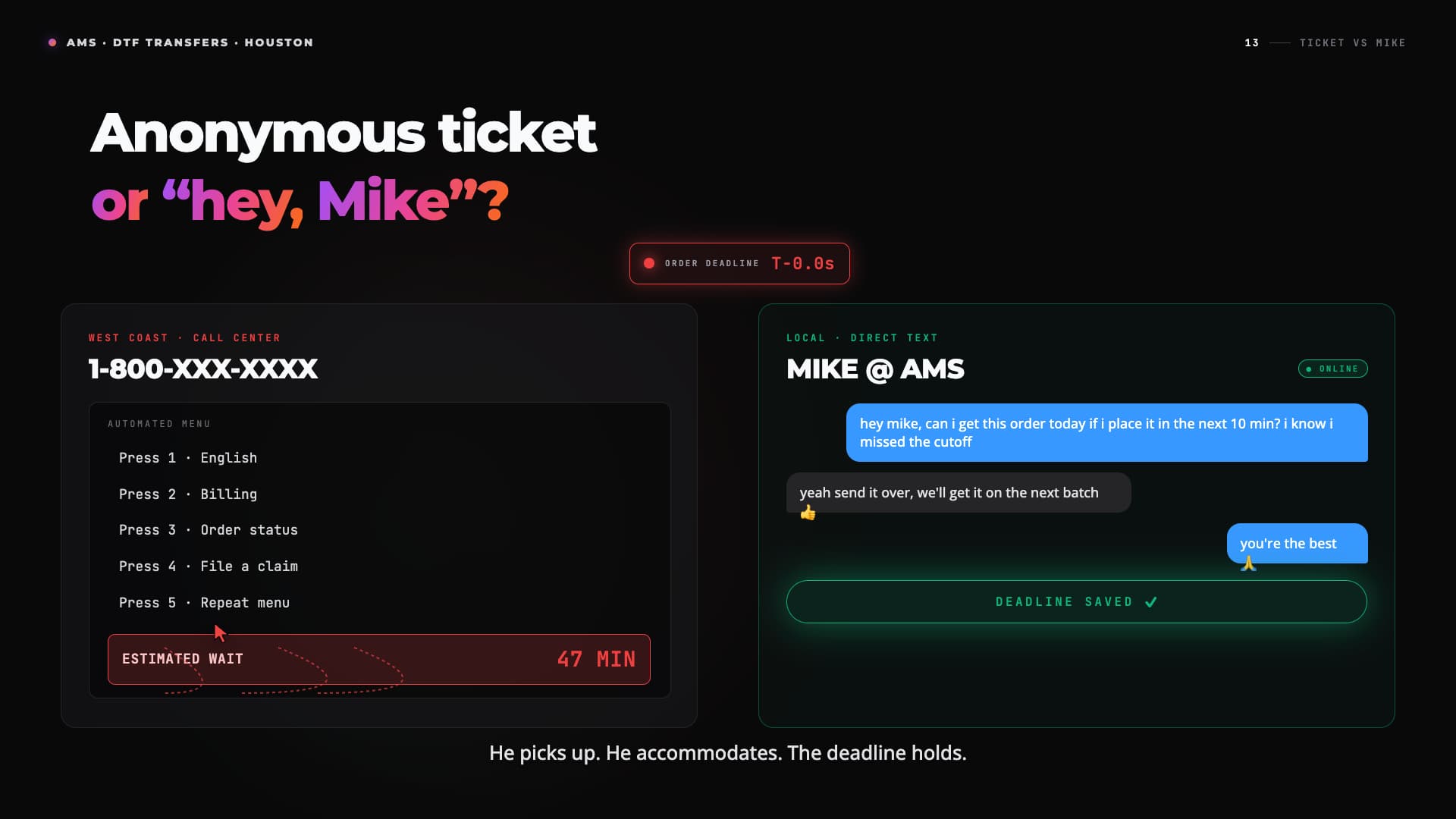
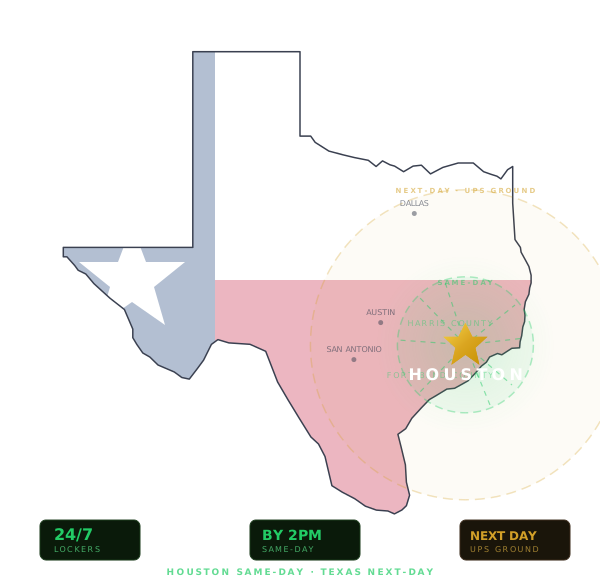
Houston DTF transfers near me searches are usually not only about distance. They are about control. If you can pick up locally, use lockers, or talk to someone before the deadline, you remove variables that a shipped transfer cannot remove.

Use local pickup when the event, school order, church group, restaurant shift, pop-up, or crew handout has a real date. Use transfer-only when your team can press. Use finished apparel when AMS should press, QC, sort, pack, and get it ready to hand out.
Houston changes the recommendation when local handoff protects the deadline better than shipping savings.
The vendor scorecard before you order
Give each vendor a simple score before paying: file help, print policy, peel type, pickup or shipping timing, support channel, replacement policy, and whether the order can survive a mistake. If the score is weak, the job needs local pickup, AMS review, or finished apparel.

This is also where DTF gang sheets fit. Use the DTF gang sheet builder after the file is clean and the real quantity is known, not before. A full sheet only saves money when every repeat is worth printing.
A vendor scorecard turns price into a decision instead of a guess.
What to send AMS for a useful recommendation
Send the artwork, screenshot or mockup, final print size, garment, quantity, size breakdown, placements, deadline, pickup or shipping preference, and any vendor quote details you are comparing. If you know pass count or peel type, include it.
If you are not sure whether to buy transfer-only, blanks plus transfers, or finished apparel, say that. A clear request lets AMS recommend the lowest-risk path instead of forcing you to guess from a product page.
The fastest AMS recommendation comes from a request that shows the real art, real deadline, and real production risk.
What to Send AMS
DTF transfer file and vendor checklist
- Artwork is final-size before the gang sheet is chosen
- Raster art is high enough resolution for the final print size
- Transparent background is real, not a screenshot or fake preview
- Tiny lines and text are at least 1 pt where possible
- Vendor can explain quality policy, samples, or pass count
- Vendor can explain replacement process if the transfer is wrong
- Shipping, pickup, and deadline are written down before payment
- Support channel is known before the order depends on it
DTF pressing readiness checklist
- Real heat press available, not a household iron
- Garment is pre-pressed for moisture
- Start with AMS application guidance: 296 to 315 F, 10-12 seconds, and high pressure
- Peel behavior is known before the full stack starts
- One test piece is pressed before the customer order
- Front/back orders have a handling plan
- Finished apparel is chosen when AMS should press, QC, sort, and pack
Choose the order path
Choose the AMS order path
All DTF transfers are not the same; choose cheap shipped transfers only when the job can absorb delay, reprint, support, and pressing risk, and pay more for local pickup or finished apparel when the deadline matters.
| Your situation | Best next step | Why | Watch out for |
|---|---|---|---|
| Flexible test design with clean artwork and no customer deadline | DTF Transfers | A cheaper shipped transfer can be acceptable when the downside is only waiting or reordering. | Still test press one shirt before filling a customer order. |
| Houston event, school, church, restaurant, or crew shirts due this week | Finished Apparel | The deadline depends on pressing, QC, sorting, packing, and handoff, not only transfer price. | Finished apparel still needs clean artwork and a real size breakdown. |
| Print shop with a heat press, trained staff, and deadline room | DTF Transfers | Transfer-only works when your team can handle test press, pressure, peel, and inspection. | Cold peel or weak transfers can add labor fast on front/back runs. |
| You found a low price but cannot verify pass count, peel type, support, or replacement policy | Ask Ams | The risk is not the low price by itself; the risk is the missing information. | If the vendor cannot explain the tradeoff, do not make a customer deadline depend on it. |
60-second order check
- Is the artwork final-size, transparent, and ready for the transfer file requirements?
- Is this a sample or a customer order with a fixed deadline?
- Does the vendor explain pass count or quality policy?
- Is the film cold peel, instant peel, or unknown?
- Can the job survive five extra shipping days?
- Can you reach support by phone, text, or local pickup if something goes wrong?
- Do you have a real heat press and a test press plan?
- Would finished apparel be safer because AMS should press, QC, sort, and pack?
AMS shortcut
Send AMS the artwork, final print size, gang sheet size if known, garment, quantity, placements, deadline, and pickup or shipping preference. We can help decide whether transfer-only or finished apparel is safer.
Quick Math
Cheap transfer hidden-cost calculator
Use this before choosing a transfer vendor by sheet price alone.
Shipped transfer comparison
$19 transfer + $9 shipping = $28 shipped
Alex compares that $28 shipped option with a $35 local pickup option, where the real question is whether five extra days and carrier risk are worth $7.
Cold peel labor example
2 hours instant peel x 1.5 = 3 hours cold peel
On a 100-shirt front/back job, Alex says cold peel took AMS about 50% longer than instant peel.
Missing-piece replacement risk
80 pieces expected - 60 returned = 20 replacement pieces
The Houston vendor story shows how a missing 20-piece gap can force new blanks, customer updates, and mental bandwidth.
Front/back handling count
100 shirts x 2 placements = 200 press checks
A weak transfer, cold peel film, or unclear application routine multiplies across every placement.
The lowest sheet price wins only when the hidden costs are small enough for the order to absorb.
Houston order examples
Houston restaurant shirts due before the weekend shift
The order risk is not only transfer price. The art, pressing, QC, sorting, packing, and pickup all have to work before staff needs the shirts.
Buyer: Restaurant operator
Qty: 36 shirts
Deadline: Friday pickup
Path: Finished Apparel
Print shop comparing cheap shipped DTF gang sheets
Transfer-only is a good fit when the shop has a heat press, can test press one shirt, and can absorb a reorder if a cheap vendor disappoints.
Buyer: Print shop
Qty: 75 front prints
Deadline: Flexible
Path: DTF Transfers
School or church event with a fixed handout date
A front/back order multiplies pressing labor, peel behavior, count accuracy, and packing risk. AMS should help decide whether local transfer pickup or finished apparel is safer.
Buyer: Event organizer
Qty: 100 shirts with front and back
Deadline: Event date cannot move
Path: Ask Ams
Brand testing a new design with no launch date
Cheap shipped transfers can be acceptable for low-stakes testing if the brand knows the delay, support, and replacement risk before scaling the order.
Buyer: Apparel brand
Qty: 10 to 20 transfers
Deadline: No fixed deadline
Path: DTF Transfers
DTF transfer vendor mistake diagnosis
| Problem | Likely cause | Prevent it | When to ask AMS |
|---|---|---|---|
| The transfer looks blurry, faded, or weak compared with the proof | Low-res artwork, poor transparent file prep, weak printer settings, low pass count, or a quality policy the vendor did not explain. | Check transfer file requirements, final size, DPI, and pass-count policy before ordering. Ask for samples or use AMS review when the job matters. | Ask AMS when the file is questionable, the customer is picky, or you cannot absorb a reprint. |
| The press run takes much longer than expected | Cold peel film, no test press, wrong pressure, too many touches per shirt, or front/back placements without a handling plan. | Use the how to apply DTF transfers guide, test one shirt, confirm peel behavior, and count labor before choosing by sheet price. | Ask AMS when the order has 50+ shirts, multiple placements, or no room for a slow press line. |
| The order is late even though the transfer price was cheaper | Shipping delay, missed delivery, damaged package, unclear cutoff, or a vendor support queue that cannot help before the deadline. | Compare local pickup, lockers, transfer turnaround, and shipping risk before the order is placed. | Ask AMS when Houston pickup would remove the carrier variable from a rush job. |
| The vendor sends the wrong quantity or loses part of the job | Weak job tracking, poor support, no replacement policy, or red flags ignored because the quote was cheapest. | Confirm count, replacement process, support contact, and pickup plan before trusting the vendor with customer-supplied blanks. | Ask AMS when a missing 20 of 80 pieces would force replacement blanks or a customer apology. |
| The transfer peels poorly or small detail fails | Wrong heat, pressure, time, fabric, film behavior, or fine details below practical print tolerance such as 1 pt lines. | Pre-press, use 296 to 315 F and 10-12 seconds as a starting point from AMS guidance, apply high pressure, test press, and inspect detail. | Ask AMS when you are not sure whether transfer-only or finished apparel is the safer path. |
Interactive Tool
Build Your DTF Transfer Request
Answer a few quick questions and we will turn your transfer details into a clean AMS request with artwork, timing, pickup, and pressing context. The builder turns your answers into a customer-facing request, an internal AMS production summary, and smart warnings before you send it.
Artwork
Upload source file, transparent PNG, vector, screenshot, or mockup
Final print size
Example: 11 inches wide full front, left chest, back, sleeve
Gang sheet size
22x24, 22x60, 22x120, or not sure
Garment
Style, color, fabric, customer-supplied or AMS-sourced
Quantity and sizes
Total transfers or shirts plus size breakdown
Placements
Front, back, sleeve, tag, multiple
Deadline
Real pickup, shipping, event, or handout date
Pickup or shipping
Houston pickup, lockers, Texas shipping, national shipping
Known vendor details
Price, shipping, pass count, peel type, support channel
Production path
DTF transfers, blanks plus transfers, finished apparel, or not sure
Frequently Asked Questions
Are all DTF transfers the same?
No. DTF transfers can differ by artwork prep, printer settings, pass count, film type, curing, support, shipping, replacement policy, and how well they apply under heat press conditions.
Are cheap DTF transfers always bad?
No. Cheap DTF transfers can be fine for samples, flexible deadlines, low quantities, and jobs where a reprint would not hurt the customer. They become risky when the deadline, quantity, support, or pressing labor matters.
Why would local DTF transfer pickup cost more?
Local pickup can cost more because it removes shipping delay, gives you a faster support path, and may protect a same-day or event deadline. In Houston, that can be worth more than a small sheet-price savings.
What should I ask a DTF transfer vendor before ordering?
Ask about file readiness, pass count or quality policy, peel type, shipping or pickup timing, replacement policy, support channel, and application instructions. If they cannot answer, do not test them on a deadline job.
Does 8-pass DTF always beat 4-pass DTF?
Do not treat pass count as the only quality factor. Alex uses 4-pass versus 8-pass to explain the time and quality tradeoff. The practical buyer move is to ask how the vendor protects print quality.
Is cold peel bad for DTF transfers?
Cold peel is not automatically bad, but it can add labor for the person pressing. Alex says cold peel took AMS about 50% longer on a 100-shirt front/back job compared with instant peel.
When should I choose finished apparel instead of DTF transfers?
Choose finished apparel when AMS should press, QC, sort, pack, and get the shirts ready to hand out. Transfer-only is better when your team has the heat press, skill, time, and test routine.
Sources
- Alex DTF transfer quality video - AMS Transfers
- AMS DTF application guide - AMS Transfers
- AMS transfer file requirements - AMS Transfers
- AMS Houston DTF Transfers - AMS Transfers
- AMS transfer pricing guide - AMS Transfers